
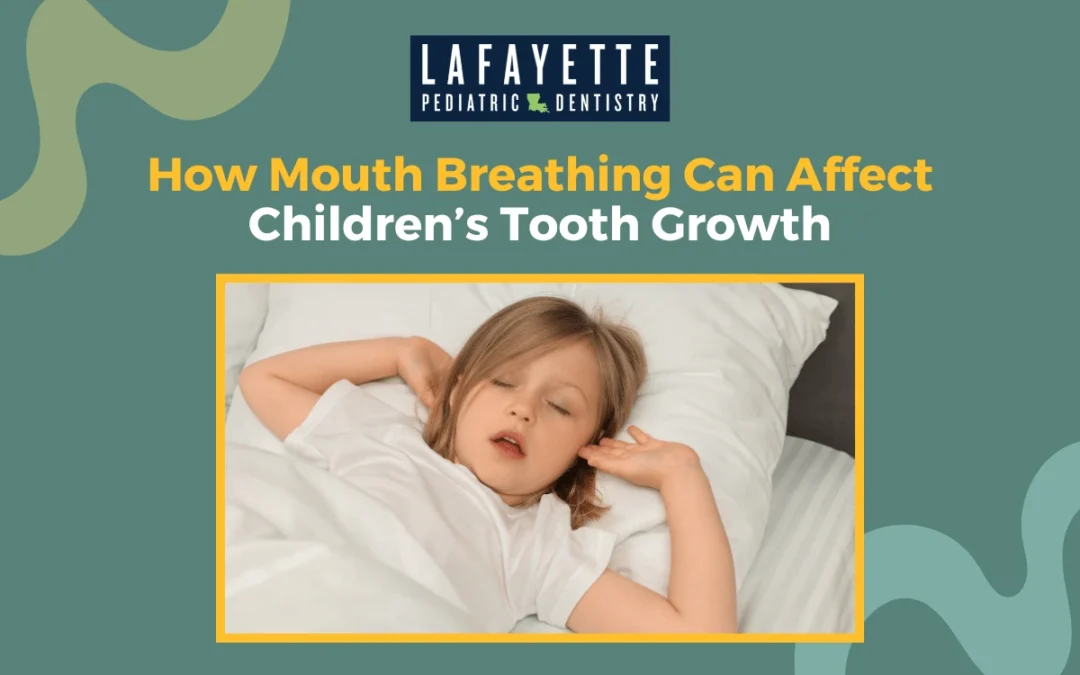
Most people don’t spend much time thinking about how they breathe. It happens automatically throughout the day and night, so it usually only gets attention when something feels uncomfortable.
Still, the habit of breathing through the mouth instead of the nose can affect oral health over time, especially during childhood when the teeth and jaw are still developing.
Occasional mouth breathing during a cold or allergy flare-up is common and usually temporary. But when mouth breathing becomes a daily habit, it can begin to affect how the teeth, jaw, and surrounding structures develop as a child grows.
How Mouth Breathing Can Affect Jaw and Tooth Development
Narrow Dental Arches
One of the more widely recognized effects of long-term mouth breathing is a narrowing of the upper dental arch.
During normal nasal breathing, the tongue rests against the roof of the mouth and applies light pressure that helps the upper jaw develop to its natural width.
When the tongue stays lower in the mouth, that pressure is reduced, and the palate can become higher and narrower over time.
As the upper arch narrows, there may be less room for teeth to come in properly. This can lead to crowding, teeth erupting at unusual angles, or a palate that appears more vaulted. In many cases, these changes develop gradually during childhood growth.
Read also: Do Crooked Baby Teeth Affect Permanent Teeth?
Changes in Jaw Development
Mouth breathing can also affect the position and development of the lower jaw. When a child regularly breathes with their mouth open, the lower jaw often rests farther back and slightly downward.
Over time, this posture can contribute to a longer, narrower facial appearance and less jawline development.
These changes can affect more than appearance alone. Jaw development also influences how the teeth come together, how comfortable chewing feels, and sometimes how clearly a child speaks.
Bite Problems That May Develop
Long-term mouth breathing has also been linked to several types of bite misalignment. One example is an open bite, where the upper and lower front teeth do not touch when the mouth closes.
Crossbites can also occur, causing the upper teeth to sit inside the lower teeth on one or both sides. In some children, overbites may become more noticeable as growth continues.
Bite problems can place uneven pressure on the teeth and jaw. Some children may find certain foods harder to chew, while others experience jaw tension or discomfort.
Teeth may also continue shifting as the jaw develops in a way that does not leave enough room for proper positioning.
Read also: Is Your Child’s Bite Off? Here’s What You Should Know About Overbites and Underbites
That being said, mouth breathing is not the only factor involved in the conditions mentioned above. Genetics, growth patterns, and other developmental factors can all contribute.
In most cases, several influences are involved. Identifying and addressing mouth breathing early can help reduce how much more involved any future treatment needs to be.
Can Mouth Breathing Be Corrected?
Mouth breathing is often a symptom rather than the underlying issue itself. Common causes include enlarged tonsils or adenoids, chronic nasal congestion related to allergies or inflammation, or breathing habits that began during an illness and continued afterward.
Because several conditions can contribute to mouth breathing, identifying the underlying cause is an important first step. Treatment can vary quite a bit depending on what is contributing to the problem.
In many cases, evaluating mouth breathing involves more than one healthcare provider. A pediatrician, an ENT specialist, and a pediatric dentist may all be involved in assessing how breathing patterns are affecting a child’s health and development. If sleep-disordered breathing is suspected, a sleep specialist may also become part of the evaluation process.
While it is not always possible to predict exactly how growth and development will progress, identifying concerns earlier can provide more treatment options as a child continues to grow.
Visit Our Pediatric Dental Team in Lafayette
If your child is showing any of the signs discussed above, or if you have questions about their oral development, our pediatric dental team at Lafayette Pediatric Dentistry is here to help evaluate their dental health and growth.
Children sometimes benefit from care outside the dental office as well. We work closely with a network of specialists and can help connect your family with the appropriate providers when needed. Contact our office to learn more or to schedule an appointment.