
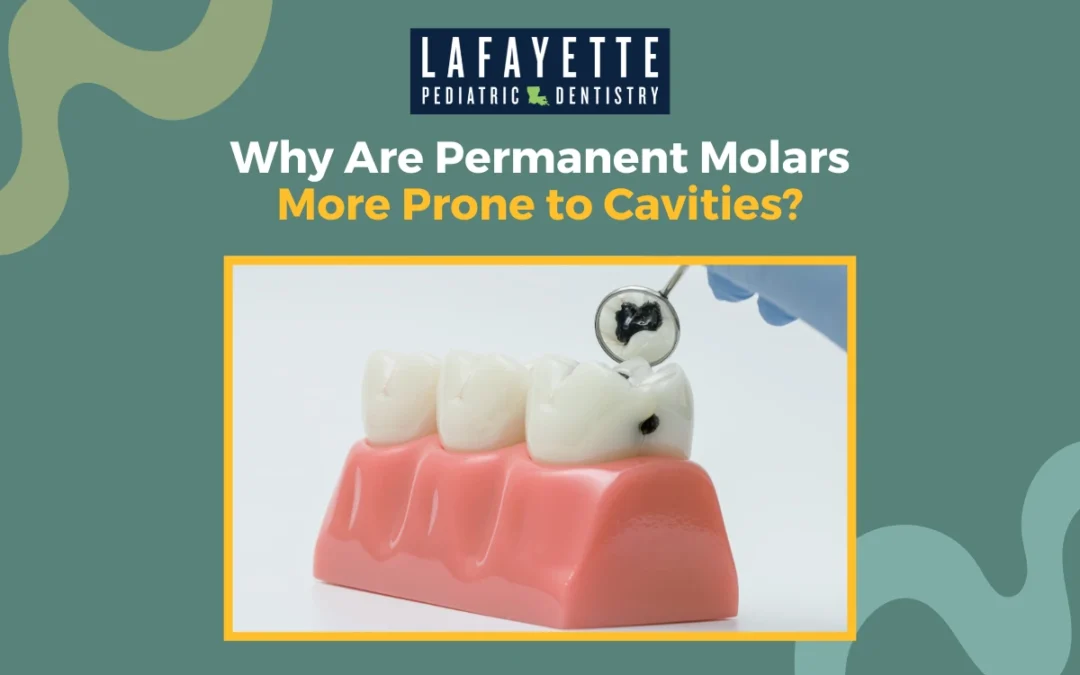
We have way more cases than we can count where kids get cavities in their molars. It’s something we see regularly, even in children who otherwise seem to have good brushing habits.
Permanent molars can be particularly vulnerable to decay, and there are a few reasons why these teeth tend to develop cavities more easily than others.
What Makes Molars Such an Easy Target for Decay
Three things make permanent molars more prone to decay: their shape, their location in the mouth, and their size.
Deep Grooves and Pits on the Chewing Surface
Run your tongue along the top of a molar and you can feel it: ridges, pits, and grooves instead of a flat surface. These areas, called pits and fissures, help molars grind food, but they can also trap food particles and the bacteria that feed on them.
The main concern is their depth. Some pits are narrower than a single toothbrush bristle, so the bristles can glide over the surface without reaching the bottom. Bacteria that settle there can remain undisturbed, producing acids that gradually erode the enamel, causing a cavity.
Their Location Makes Them Harder to Clean
Permanent molars sit at the very back of the mouth, past the premolars, which can make them harder to reach with a toothbrush and harder to see in a mirror.
This can be especially challenging for a 7 or 8-year-old with a smaller mouth and developing hand coordination. Kids may focus on the front teeth they can see and spend less time on the back teeth.
The last molar in each row can be especially easy to miss because it sits close to the cheek. Without someone checking their brushing, these teeth can sometimes receive only a quick pass of the toothbrush.
Molars Have a Large Chewing Surface
Molars are the largest teeth in the mouth, and it’s built for grinding. Their broad chewing surfaces give plaque more room to collect and spread, which can increase the chance of cavities. Brushing removes much of the plaque buildup from a small, flat tooth, but a molar’s wide, uneven surface can leave some plaque behind.
What Parents Can Do to Prevent Cavities in Permanent Molars
None of this means a cavity in a molar is inevitable. It simply means these teeth need extra attention, especially during the first few years after they come in.
Encourage Thorough Brushing
Two minutes of brushing twice a day with fluoride toothpaste is still the baseline. For molars, have your child angle the toothbrush so the bristles reach into the pits and grooves rather than sweeping across the surface.
Spending a few extra seconds on each back molar, including the top and both sides, can also help remove plaque in areas that are easy to miss.
Most kids do not have the hand coordination to brush their molars thoroughly until around age 7 or 8.
Even after that, finishing the job yourself for under a minute each night until your kid gets a bit older can help catch areas your child may have skipped. Stand behind your child, tilt their head back slightly, and give the back molars one final pass.
Read more: What Toothbrush Do Dentists Really Recommend for Your Kids?
Floss Between Molars
A toothbrush cleans the front, back, and top of each tooth, but it cannot reach the tight spaces between molars. Food can become trapped in these areas after meals, and plaque can build up between the teeth. Flossing once a day, ideally at night, removes debris and plaque that brushing leaves behind.
Read more: Brushing Alone Isn’t Cutting It: Teaching Kids the Value of Flossing
Schedule Regular Cleanings and Checkups
Cavities in molars are not always visible to the naked eye, especially in their early stages or between teeth. A pediatric dentist can use dental tools and X-rays when needed to check for decay that may not be visible during a routine look. Regular cleanings also remove plaque that brushing and flossing may miss at home.
Limit Sugary Snacks and Drinks Between Meals
Sipping juice or grazing on sticky candies throughout the day keeps sugars available to the bacteria in plaque, which allow acids to repeatedly attack the enamel.
Gummy candy especially can stick to the depths of your child’s molar’s grooves long after your child is done eating them! Save sweets for mealtimes and offer water instead of juice or sports drinks between meals to give your child’s teeth time between exposures to sugar.
Add Extra Protection With Dental Sealants
Talk with your pediatric dentist about adding dental sealants. A sealant is a thin coating of dental resin applied to the chewing surface of a molar. It acts like a caulking over the deep pits and grooves, leaving fewer spaces where food and bacteria can collect.
Applying a sealant usually takes only a few minutes in the dental chair and does not require drilling or numbing. Sealants can last for several years, although your child’s dentist should check them during regular dental visits.
Sealants have the best chance of preventing decay when they are placed soon after a molar erupts, before decay develops in the grooves.
Read more: Dental Sealants: How They Can Benefit Your Child’s Oral Health
Protecting Your Child’s Molars for the Long Run
Permanent molars handle much of the day-to-day work of chewing, but their deep grooves, location at the back of the mouth, and larger chewing surfaces can also give plaque more places to collect. With regular brushing, flossing, dental checkups, and preventive care, you can help keep your child’s molars healthy as they grow.
If you are a parent or guardian in Lafayette, Broussard, Youngsville, Breaux Bridge, or anywhere else in Acadiana and have questions about preventing cavities or caring for your child’s teeth, our pediatric dental team is happy to see you and discuss your child’s oral health needs.