
Key Takeaways
- Crowns are often recommended for baby teeth with extensive decay, cracks, or weak enamel that cannot be treated with a filling alone.
- Stainless steel crowns are silver in color and highly durable. They are commonly used on back teeth.
- Tooth-colored crowns resemble natural teeth and often may require more tooth structure removal.
- No single type of crown is right for every child. Your pediatric dentist can explain the available options and help you choose one based on your child’s dental needs.
Hearing that your child needs a dental crown can catch you off guard. We usually recommend crowns when a tooth has decay that is too extensive for a filling, has cracked or broken after a fall, or has weak enamel due to developmental issues or previous dental treatments.
A crown covers the entire visible portion of the tooth, much like a cap. This protects the remaining tooth structure until the baby tooth naturally falls out.
Two common types of dental crowns for children are silver stainless steel crowns and tooth-colored zirconia or composite crowns. Each has different features, including appearance, durability, and how much of the natural tooth needs to be removed before placement. Understanding these differences can help you feel more prepared for your child’s dental appointment.
Tooth-Colored Crowns for Kids
Tooth-colored crowns are made to blend in with your child’s surrounding teeth. Two common types are used in pediatric dentistry:
Zirconia crowns
- Made from a durable ceramic material that resists wear and staining.
- Requires significantly more shaving of the tooth structure to get a good fit
- If your child is very crowded, there may not be enough room to place a zirconia crown
- Not adjustable after placement
Composite strip crowns
- Made using a clear plastic form that is filled with tooth-colored composite resin. Once the resin hardens, the form is removed, which leaves a crown that matches the natural tooth.
- Does not require as much shaving of the tooth to place; more conservative
- Slightly better esthetics, and are also adjustable after placement
- Tooth-colored crowns also generally cost more and are more technique sensitive than stainless steel crowns, which means they can be harder to place on a child who is not able to cooperate for dental work.
Stainless Steel Crowns for Kids
Stainless steel crowns are premade metal caps available in different sizes. Your dentist selects the size closest to your child’s tooth, makes any needed adjustments, and cements the crown in place.
Here are some of their main features:
- They have a silver, metallic appearance.
- They are highly durable and can handle daily chewing.
- They cover the entire visible portion of the tooth to help the remaining natural tooth structure.
- They generally cost less than tooth-colored crowns.
- They typically require relatively little tooth preparation before placement.
Stainless steel crowns are often recommended for molars because back teeth handle most of the chewing. Baby molars can remain in place until around age 12, so they need restorations that can withstand regular use over several years. Since back teeth are less visible, appearance is often less of a concern.
The main drawback of stainless steel crowns is their appearance. Some children think having a silver tooth is fun, while others may feel self-conscious about it, especially if the crown is visible when they laugh or talk.
Read more: How to Handle Lost Fillings or Crowns in Kids
Key Differences Between Stainless Steel and Tooth-Colored Crowns
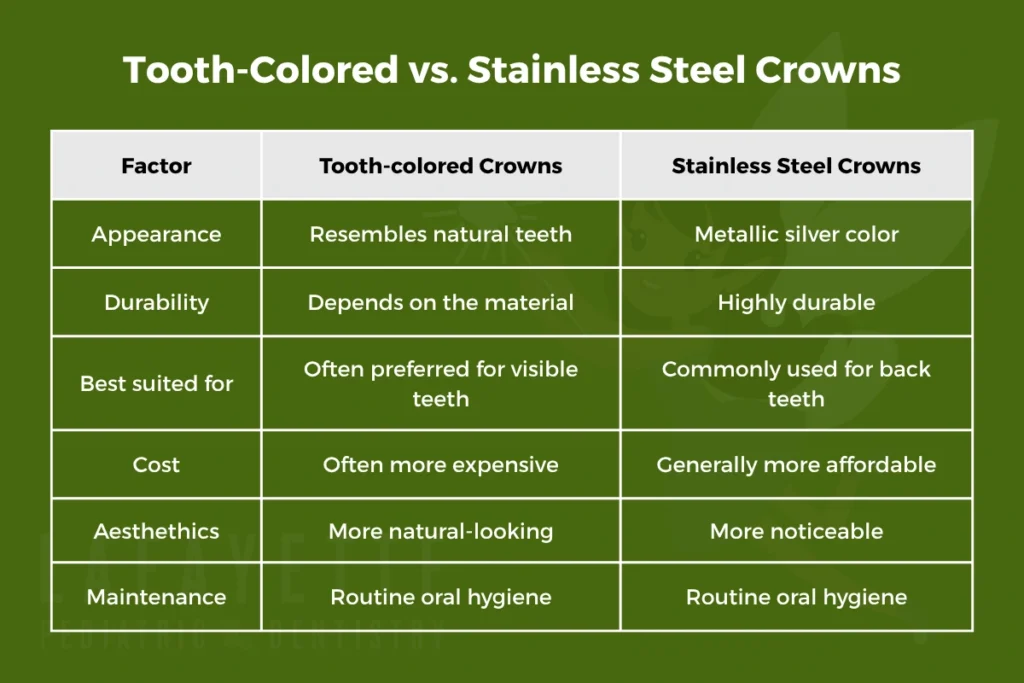
As you can see, both types of crowns require the same daily oral care. Neither replaces brushing and flossing, and the natural tooth underneath can still develop decay near the gum line if plaque builds up.
Your child should continue the regular oral hygiene routine, even after getting a dental crown. Regular dental checkups are also important for monitoring the crown and the surrounding teeth.
Read more: Does My Kid Really Need a Dental Crown?
Which Type of Crown is Best for Your Child?
There is no single type of crown that is best for every child. Your pediatric dentist will consider several factors before recommending an option, including:
- The tooth’s condition and surroundings: How much natural tooth structure remains and whether the child’s mouth exhibits overcrowding.
- How long the tooth needs to remain: How much time is left before the baby tooth naturally falls out.
- Your child’s chewing habits: Whether your child has habits such as teeth grinding or clenching.
- Appearance preferences: How your child feels about having a silver or tooth-colored crown.
- Cost and insurance coverage: Your budget and the types of crowns covered by your dental insurance.
Your dentist can review these factors with you and explain which crown options are appropriate for your child’s dental needs.
Our pediatric dental team has served families throughout the Acadiana area for over 15 years, including Lafayette, Youngsville, Broussard, Breaux Bridge, and Carencro. We provide comprehensive restorative dentistry for children and adolescents, including dental crowns, along with preventive care and specialized dental services.
We are here to help you care for your child’s oral health and answer any questions you may have about their dental needs. You can request an appointment online or call our office to schedule a visit.